Settings feel overwhelming until you realise there are really only a few that matter at an event. The rest is muscle memory.
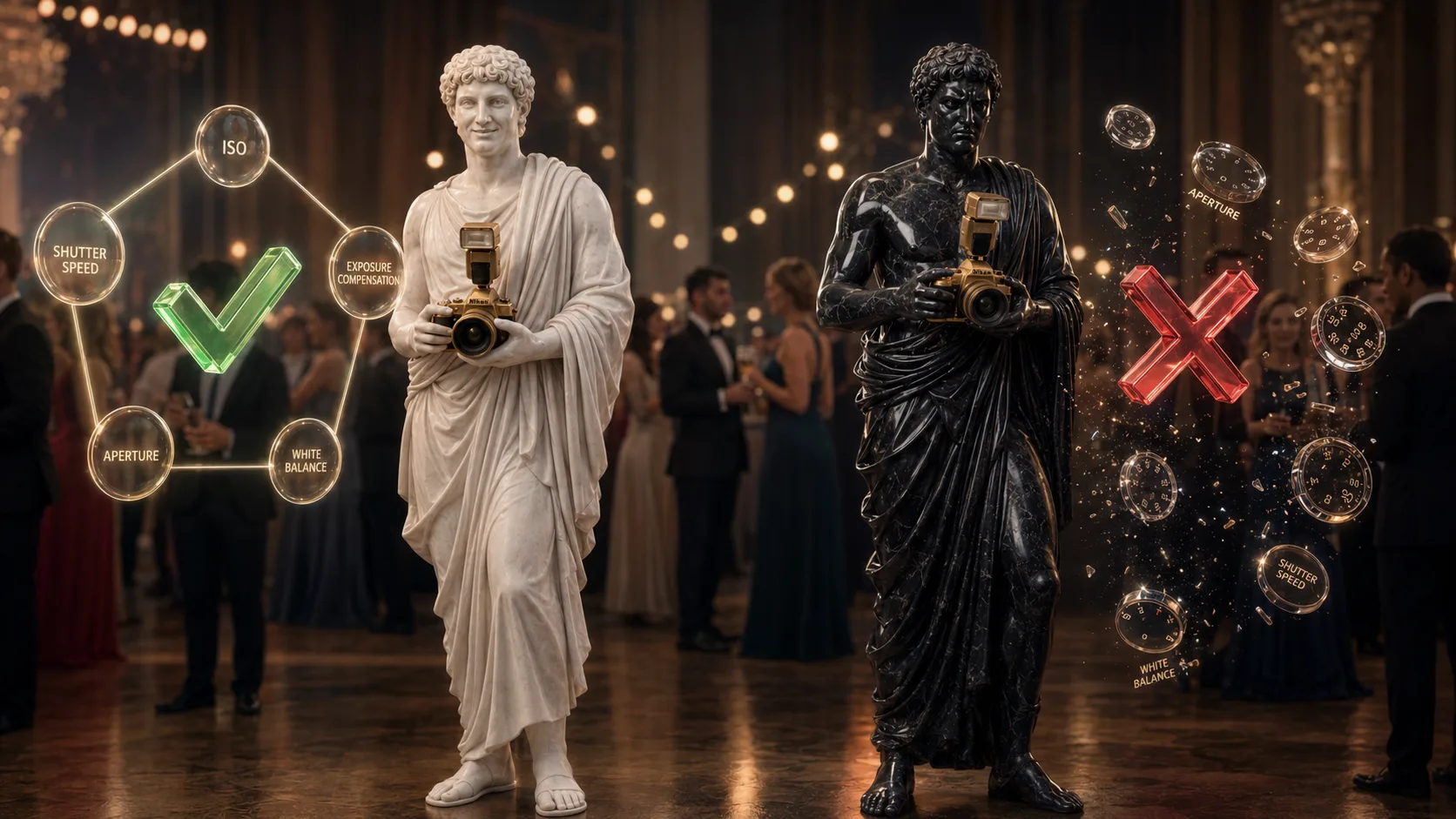
The Exposure Pentagon: Why Events Break the Triangle
Most photographers first learn exposure as a triangle of aperture, shutter speed, and ISO. That model works for natural light. The moment you introduce flash into a dim reception hall or a club, the triangle is no longer enough to describe the scene. EP101 calls the expanded model the Exposure Pentagon.
Think of ambient light as the base spirit of your photograph and your flash as the mixer. The ambient is already in the room — candle glow, stage wash, the last daylight coming through a window. Your flash is the light you add on top. A great event photograph blends both so the subject is clearly lit but the mood of the room survives the burst.
- ⚙️ Shutter speed — how much ambient soaks into the frame (your background)
- ⚙️ Aperture — controls subject brightness and background blur
- ⚙️ ISO — the amplifier that lifts everything together
- ⚙️ Flash power — the intensity of the burst from your speedlite
- ⚙️ Flash-to-subject distance — how hard that burst hits your subject
The single takeaway: subject too bright but the background looks great? Turn down the flash or step back half a pace. Background pitch black? Slow the shutter to let more ambient in. Everything dark? Raise the ISO before you max out your flash — it lifts both the ambient and the flash at once.
The Four Camera Body Priorities
The camera should feel like an extension of yourself, never something that slows you down. Dozens of specs compete for your attention, but four carry the real weight for event work.
- 🎯 Autofocus — effortless and accurate in fast-moving scenes
- 🌙 Low-light performance — clean files at ISO 3200 and above
- 💾 Dual card slots — physical insurance, a baseline for paid work
- 🔗 Lens ecosystem — you buy into a system, not just a body
Don't chase megapixels. A confident autofocus system and a clean high-ISO sensor will save more moments than any resolution bump ever will. Buy for the rooms you actually shoot, not the spec sheet.
Lens Strategy: Buy for Function First, Impact Second
Event photographers do not need a bag full of lenses. They need the right two, bought in the right order — because that order reflects how you actually build a gallery.
Your first lens is for function: a standard zoom. A 24-70mm f/2.8 on full-frame (or a 16-50mm equivalent on APS-C) covers an enormous range without forcing a lens change mid-crowd — wide establishing shot one moment, group photo the next. This workhorse carries the majority of your coverage and should live on your camera more than any other lens.
Your second lens is for impact: a telephoto prime. An 85mm f/1.8 on full-frame (or a 56mm f/1.4 on APS-C) is the lens you reach for when you want bokehlicious candids and portraits with a shallow depth of field. It isolates a single guest laughing or a couple in a quiet moment and turns them into the visual centerpiece of the gallery — compression and separation that simply cannot be faked with a zoom.
Avoid: skipping the standard zoom for a cheaper prime. Function comes first because coverage comes first. You cannot build an entire event on shallow depth of field alone.
Flash: Take Control Without Killing the Mood
Flash is not optional in event photography. Sooner or later you walk into a venue where the ambient is too dim, too colorful, or too inconsistent to rely on. The question is never whether to own flash gear, but how to use it without flattening the mood of the room.
Start with a dependable external speedlite, not the camera's built-in pop-up flash. The single most useful technique in event lighting is bounce: aim the head at a ceiling or nearby wall and a large surface becomes a soft, diffused light source that wraps around your subject. A compact speedlite with a bounce card will carry you through ninety percent of events — everything else is an advanced layer. Carry spare batteries always, and treat flash as an essential system, not an accessory.
Do this: pair this section with the dedicated Flash Guide for bounce logic, TTL versus manual, and drag-and-burn. Gear without flash technique is only half a kit.
Starting Settings: Choose by the Job of the Shot
There is no single set of settings that works for every event, but there are reliable starting points you default to and then adjust. Choose your settings based on the job of the shot, not on a formula you memorized once. A solo portrait asks different things of your camera than a crowded dance floor or a detail flatlay — let the subject in front of you decide the dial.
- Aperture follows head count — more people in the frame, stop down to keep them sharp.
- Shutter speed follows motion — freeze it fast, or drag it slow to let the ambient smear and the dance-floor energy bleed through.
- ISO is your fine tuner, not your first lever — raise it in dark rooms before you max out your flash. A noisy photo that is properly exposed always beats a clean one that is too dark to use.
Lock your white balance. In dark rooms and late receptions with flash, set a manual white balance around 6600K for flattering, consistent skin tones. Chasing auto white balance through a room of mixed coloured lights will leave your gallery looking inconsistent no matter how carefully you edit.
RAW Is the Safety Net
Shoot in RAW. For event work there is no real counterargument, and the reason comes down to how much data each format holds. A JPEG is an 8-bit file — think a small box of crayons, fine for sharing but quick to fall apart under pressure, with skin tones that look artificial and blown highlights that cannot be recovered.
A RAW file is 16-bit — over 65,000 shades per color, a giant box of crayons that retains the maximum sensor data. It lets you recover blown highlights and rescue shadow texture in post without destroying the image. In an event where exposure is constantly shifting and you cannot always reshoot, RAW is the bigger net — the one that saves the photos that matter most. Write RAW to your primary card and smaller JPEGs or HEIFs to your secondary card as a live backup.
Memory Cards & the 3-2-1 Backup Rule
Memory cards are the airplanes that carry your moments from the camera to your computer, so never skimp on them. Use fast, high-capacity cards so the camera does not buffer or stall mid-burst — a frozen buffer at the wrong second will cost you the shot you cannot recreate.
The 3-2-1 backup rule: keep three copies of your files, two stored locally on different drives and one stored off site in the cloud. Only once all three copies are verified do you format your cards for the next job. Unglamorous? Yes. The difference between a professional workflow and a disaster waiting to happen? Also yes.
The Gear Is Just the Beginning
Gear removes friction. Settings remove guesswork. But neither one will hand you the eye, the timing, or the people sense that actually carries an event from ordinary to unforgettable. That deeper craft — reading a room, anticipating moments, building a gallery that moves people — is where the real work lives.
If this guide tightened your grasp of the Pentagon, your lenses, and your starting settings, good — that is the foundation. When you want the rest of the framework — exact settings tables, the full flash workflow, and the moment-by-moment decision trees that help you make calm choices in ugly rooms — Event Photography 101 brings it together in one place. 📘